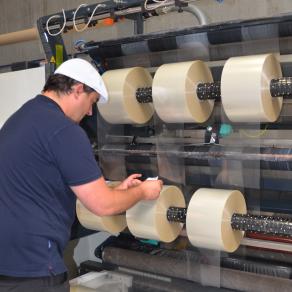
Challenges in the packaging world
Food companies and producers face many challenges when it comes to packaging materials, which raises questions and uncertainties: certification, keeping up with changes in legislation, tackling emerging hazards and ethical questions about sustainability. Our Normanists are the perfect allies to help you tackle them.
Declaration of Compliance (DoC) - Verklaring Van Overeenstemming (VVO)
Food companies can rely on us for everything related to the DoC: the correct evaluation, the minimum information it must contain, and which foods and applications the packaging material is suitable for.
We help packaging companies draw up the DoC correctly and substantiate it fully by collecting the right product information. We build on scientific data, choose the right parameters for migration testing and/or use calculation methods.
Risk analysis - HACCP
AMNorman supports you in creating or revising your HACCP plan. We map all hazards related to packaging materials and assess their impact on and/or risk to your end product.
We plan regular updates by monitoring new and emerging hazards through RASFF analyses.
Bioplastics versus conventional packaging
Do you want to switch completely from conventional packaging to biodegradable, compostable and/or bio-based packaging materials? You can count on us. We provide the necessary advice and map all important and relevant factors.
Think, for example, of machinability (flow-pack sealability, thermoforming equipment, etc.), the required barrier properties (OTR/WTR), the impact on the final shelf life, suitability for certain foods and the field of application (temperature profile).
For packaging producers, we think mainly in terms of procedures and focus on the possible end applications. We also evaluate food safety by looking closely at the composition of the material and determining the required migration tests.
Support with certification
Packaging companies are receiving more and more requests from customers to obtain a quality certificate. An upgrade is often necessary, as an ISO 9001 certificate is no longer enough.
AMNorman supports you in obtaining BRCGS Packaging Materials, FSSC 22000 Packaging or IFS PACsecure certification.
This can be done by outsourcing the project entirely to AMNorman or as a joint project for which we draw up a clear, targeted step-by-step plan. Throughout, we focus fully on your company's needs, with simplicity and efficiency.
Re-engineering
Quality systems and manuals are often outdated, complex and bulky. This makes them hard to use in practice and an administrative burden.
Our Normanists focus on simplification, making quality management workable now and in the future. Of course, the revised system remains compliant with all legal and normative requirements.
Internal audits
Internal audits are a powerful tool for continuous improvement. They require audit skills and knowledge of the standard, and experience in the sector is a major advantage. Our Normanists are the perfect partners to provide an objective analysis with the required expertise. They suggest solutions to problems while respecting confidentiality.
Alternatively, you can opt for in-house training, in which a newly formed company team is trained to carry out internal audits so that it can later do so independently.
Frequently asked questions about packaging safety
What is IFS PACsecure?
IFS PACsecure is the international IFS standard specifically for manufacturers of packaging materials (flexible packaging, plastics, paper, metal, glass). The current version is version 3 (since 2024), with a doctrine update in July 2025 that clarifies its practical application.
Which legislation is relevant to packaging materials in contact with food?
At European level, mainly Regulation (EC) No 1935/2004 (the framework regulation on food contact materials) and, for plastics, Regulation (EU) No 10/2011, which sets limits for migration into food.
What will the PPWR change for packaging manufacturers?
The PPWR (Packaging and Packaging Waste Regulation) is gradually introducing stricter requirements on recyclability, reuse and material use, with deadlines from 2026 to 2030. For packaging manufacturers, this means, among other things, demonstrable recyclability criteria for each packaging category. See also our knowledge centre articles on the PPWR for the latest developments.
How is migration from packaging materials into food tested?
Through standardised migration tests (overall migration limit and specific migration limits) that determine how much of a substance can transfer from the packaging material into the food under realistic storage and use conditions, assessed against the legal limits.
Further reading in our knowledge centre
Our customers testify
Support with quality system according to FSSC 22000
In collaboration with AMNorman, we keep our quality system at the highest level and have successfully achieved the FSSC certificate for years!
Alain Tuybens, Cirepa
Implementation BRCGS packaging materials
We worked with AMNorman for the first time to adapt our quality system to the BRCGS Packaging Materials version 6 standard. We learned a great deal from this and, partly thanks to their support, achieved an excellent AA score on our audit.
Anja D'hossche, Avamoplast

implementation BRCGS packaging materials
Thanks to the support of AMNorman, our quality system is fully in order and in 2020 we achieved our first BRCGS Packaging Materials certificate.
Pauline Van Acker, Packas