Food allergens
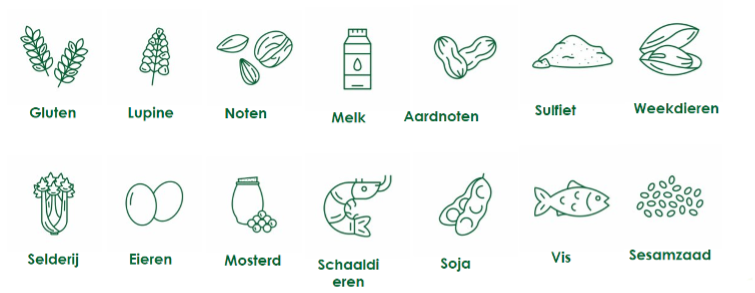
European legislation (Regulation (EU) No 1169/2011) lists 14 allergens that are subject to mandatory information requirements.
Rules for prepacked and non-prepacked foods
The legislation differs for prepacked and non-prepacked foods. A food is only considered prepacked if several conditions are met. If any one of these conditions is not met, the food is not considered prepacked:
- the food must be packaged before it is offered for sale;
- it must not be possible to alter the contents without opening or damaging the packaging;
- it must not be a food that is prepacked for direct sale.
What is meant by direct sale?
This covers prepacked foods that are sold:
- at the establishment where they were produced, OR
- at establishments run by the same operator as the establishment where they were produced, for operators running a maximum of five establishments, provided that the date of minimum durability or the "use by" date is stated on the packaging of these foods.
Prepacked foods
Clear allergen labelling on prepacked products is crucial. Allergens must be listed in the list of ingredients and must stand out clearly from the other ingredients, for example by printing their names in bold, in capital letters or in a different colour. If there is no list of ingredients (e.g. for alcoholic beverages with an alcoholic strength by volume of more than 1.2%), the word "contains" is used, followed by the name of the allergens.
Would you like to know more about the mandatory particulars a label must contain? Consult our experts or take a look at our training calendar.
Allergen management for non-prepacked products
Allergen legislation
The Belgian Royal Decree of 17/07/2014 laying down provisions on the communication of certain substances and products causing allergies or intolerances in non-prepacked foods imposes a wide range of rules. Every restaurant, café, bakery, butcher's shop and so on (in short, anyone who produces food and sells it directly to consumers) is required to provide customers with allergen information.
This may be provided in writing or verbally.
Allergens on the menu
An example of written information: for dishes with a fixed recipe, a restaurant can list the allergens on the menu. Please note: this is not mandatory! By using symbols, you can indicate which allergens each dish contains. AMNorman has designed icons that you can download and use on your menu.
Allergens in the hospitality sector
In collaboration with Horeca Academie and Horeca Forma, we provide training courses on allergens in the hospitality sector (horecavlaanderen.be, in Dutch) and allergen legislation in practice (Horeca Forma, in Dutch).
FASFC rules
Since 2015, the FASFC has published its inspection results online for consumers. Anyone can check how your business scored during an inspection by means of a scoring system.
The FASFC has become very strict when it comes to allergen information. If you do not comply with the legislation, you may receive an official report with a fine. In addition to the FASFC, a dissatisfied customer can also file a complaint against you or report you to the FASFC. The legislation therefore increases food safety for consumers. Consumers can hold the food business operator liable for allergic reactions and any resulting injury. If the consumer was informed about the allergens in the product, the hospitality business is not liable for any adverse consequences. Consumers remain responsible for deciding whether or not to eat the food.
Allergen management for food companies
Our Normanists help you set up an allergen management system tailored to your company. A well-founded risk analysis with the right validation techniques forms the basis. We also regularly provide training courses and workshops on allergen management. You will find all the details under 'our training courses'.
News
Expertise
Frequently asked questions about allergen management
Which allergens must be declared on a label?
European legislation (Annex II to Regulation (EU) No 1169/2011) recognises 14 allergens that must be declared: gluten, crustaceans, eggs, fish, peanuts, soybeans, milk, nuts, celery, mustard, sesame seeds, sulphites (above a certain concentration), lupin and molluscs.
What is the difference between an allergy and a food intolerance?
An allergy is an immune response that can have serious, sometimes life-threatening consequences, even with small amounts. An intolerance (such as lactose intolerance) is a digestive problem without an immune response, usually less acute but still troublesome. Both call for careful labelling, but the legal obligation concerning the 14 recognised allergens relates specifically to allergic reactions.
How do you prevent allergen cross-contamination in production?
Through a combination of measures: physical or time-based separation of allergenic and non-allergenic production lines, a well-planned production schedule (low-allergen products first), thorough cleaning validation between production changeovers, separate storage and colour-coded equipment, and staff training. An allergen risk assessment (allergen mapping) is the starting point.
Is the statement “may contain traces of” a legal requirement?
No, this precautionary statement (PAL, precautionary allergen labelling) is voluntary and not regulated at EU level, which leads to inconsistent use in practice. However, it must not simply be added systematically as an easy cover for inadequate risk control: a well-founded risk assessment must show that the risk of cross-contamination is real before the statement is justified.
Further reading in our knowledge centre