What are inhibitory substances and how are they detected in raw milk?
On 15 December 2021, the Belgian Federal Agency for the Safety of the Food Chain (FASFC) published a new circular on rapid tests and microbiological inhibitor tests for detecting antibiotic residues in raw milk. The changes it introduces took effect from 01/07/2023.

Anton Bauters
In December 2021, a new circular was published concerning rapid tests and microbiological inhibitor tests for detecting antibiotic residues in raw milk. The changes it mentions took effect from 01/07/2023. This transition period gave dairy producers and other stakeholders enough time to take the necessary steps. In this blog, you'll read which changes were introduced and how the test procedure works.
What are inhibitory substances?
To make the rest of this text easy to read and interpret correctly, we would like to clarify a few key concepts.
- Inhibitory substances: substances that inhibit bacterial growth.
- Raw milk: milk secreted by the mammary gland of one or more milk-producing animals, which has not been heated above 40°C or subjected to a treatment with equivalent effect.
How are inhibitory substances detected?
When drawing up the risk analysis in a dairy company, account must be taken of the possible presence of antibiotics in raw milk.
Antibiotics are only permitted in the primary sector under strict conditions. This is why the veterinarian who supplies and, where applicable, administers antibiotics on the farm must register this in the AB Register. The same applies to the farmer, who in turn must register all use.
After antibiotics have been administered, a certain withdrawal period must pass before the animal's milk may be returned to the circuit for further production. After this withdrawal period, rapid tests are used on receipt at the dairy company to get the milk into production as quickly as possible.
The approved rapid tests can be found in a circular drawn up by the FASFC, which was amended on 15/12/2021. Some rapid tests were removed and one new one was introduced.
How does the test procedure work?
Test procedure shown schematically
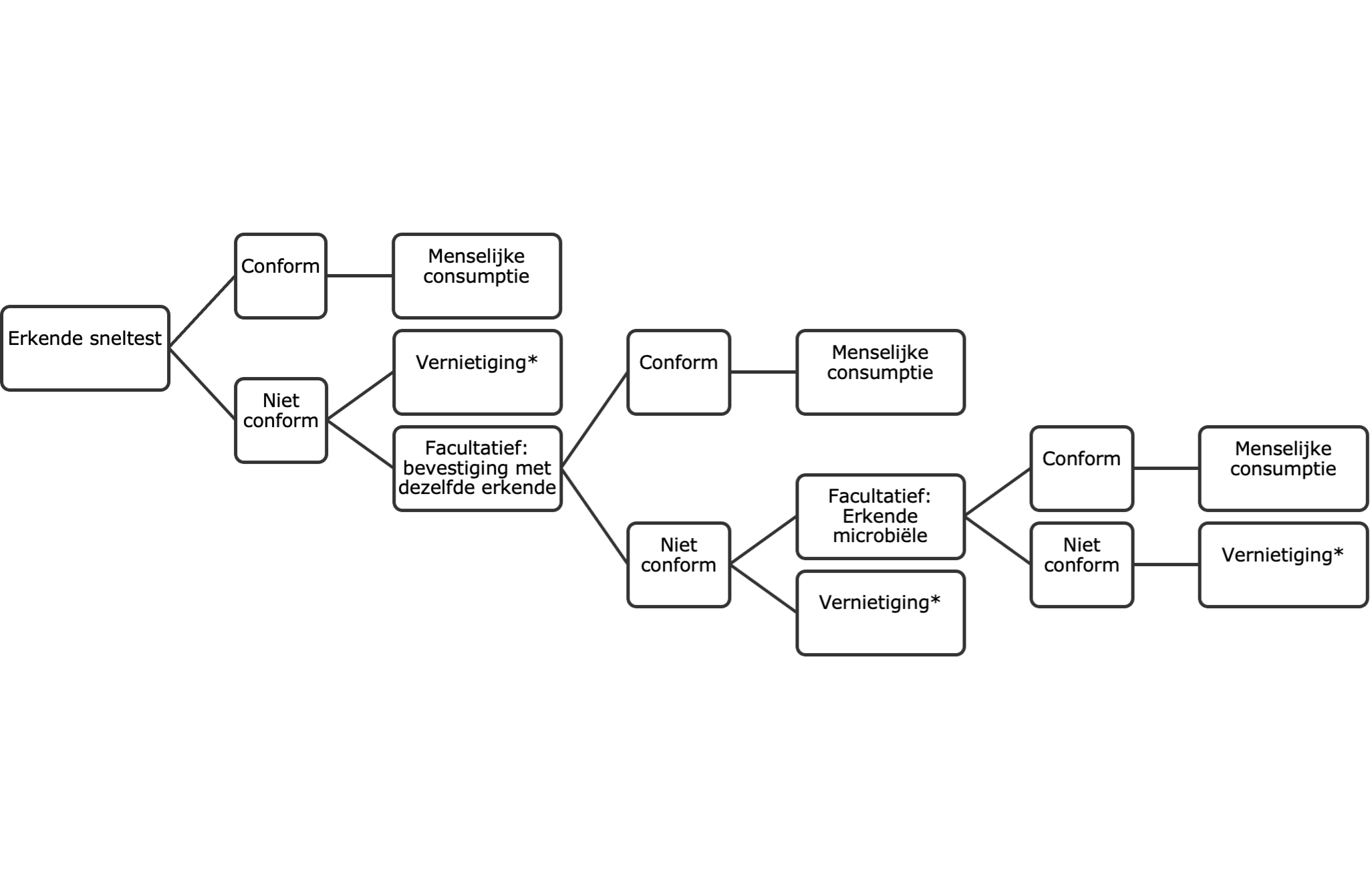
Brief explanation of the diagram
Raw milk received must be subjected to an approved rapid test. Such a test can produce two possible results:
- Compliant: the milk may be processed by the dairy company.
- Non-compliant: the milk is destroyed (no animal or human consumption possible) or subjected to a retest (mandatory, with the same rapid test).
If, after a retest, the milk is still non-compliant, it is destroyed or subjected to an approved microbiological inhibitor test. Given the purpose of the test, both microtiter plates and ampoules are suitable. This analysis is not mandatory, but allows the high sensitivity of the rapid test to be corrected.
Conditions a microbiological inhibitor test must meet:
- The test must be validated by a national reference laboratory or by a laboratory accredited and approved by the FASFC.
- Tests placed on the market after 2010 must be validated according to the CRL guidelines.
- The test must be approved by the FASFC after assessment of a validation dossier drawn up by a national reference laboratory.
- If the FASFC considers it necessary, additional advice from the FASFC's Scientific Committee may be requested.
If the result of this test is compliant, the milk may still be put into production for further processing.
What happens to non-compliant milk?
When it can be shown that the raw milk contains inhibitory substances, this must be reported to the FASFC. Under Regulation (EC) No 1069/2009, such milk is considered category 2 material and must be collected and destroyed. In addition, a sample of the contaminated milk must be kept for one month at a temperature below -18°C.
Ensuring correct testing through ring trials
To ensure that competent, trained staff carry out the tests correctly, you can take part in a ring trial.
- This involves a series of 8 ring samples, containing both pure milk and milk contaminated with antibiotics, provided for analysis using the rapid test applied in the company and, where applicable, the microbiological inhibitor test.
- The blind-coded milk samples are delivered to the participating producers, who must then report back the results obtained.
- The results obtained per test are then evaluated in a comparative study.
- Each producer receives a complete overview of all results from the various participating companies, in the form of a report that safeguards anonymity.
- In the event of strongly deviating results, the producer concerned will be contacted to determine the cause so that corrective measures can be taken.
We're here to help
AMNorman has the right experts to provide you with tailored information. Our Normanists ensure the circular is implemented correctly and on time in your company, so every inspection goes smoothly. We also help dairy companies draw up the correct procedure for checking antibiotics on receipt of raw milk.