Sustainable consumption continues to grow. In the ‘Monitor duurzame voedselkeuzes’ (sustainable food choices monitor), Flemish consumers say they need correct, clear and simple information.
Focusing on sustainability labels can add value to your company.
Below is an overview of the six most important sustainability labels in the food industry for which you can count on our support.
BIO certification

Do you want to produce or sell organic products? Then you need an organic (BIO) certificate. A BIO certificate guarantees that you comply with all organic regulations and legislation. The most important points for BIO certification:
- separation in time and/or space of organic and conventional products
- traceability and mass balance
- ingredients produced by organic farming
- specific organic labelling rules
- genetically modified organisms and treatment with ionising radiation are prohibited
AMNorman's consultants advise you on applying the organic legislation (Regulation (EU) 2018/848) and support you during the certification audit.
Sustainability quality marks
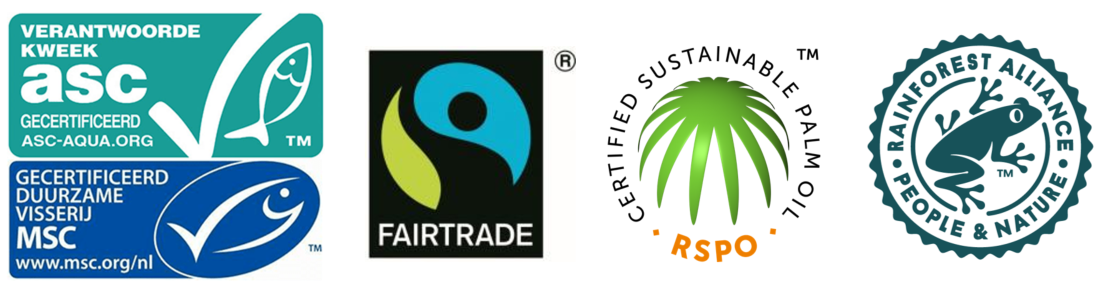
MSC & ASC
The Marine Stewardship Council (MSC) label is an international label for sustainable fish. It guarantees that wild fish have been caught with respect for the environment and animal welfare. This means that every fish carrying the MSC label was caught 100% sustainably, without harming the ecosystem. There is also the Aquaculture Stewardship Council (ASC) label for sustainably farmed fish and seafood such as salmon, tilapia, trout, pangasius, shrimp and seaweed. Products with this label have been produced under good working conditions and with respect for the environment. The ASC label also takes animal welfare into account: a health plan is drawn up for the farmed fish in every case, and antibiotics and other medicines are not administered.
Fairtrade
Fairtrade is an international label for fair trade with the Global South. You can find it on food products, textiles and cosmetics, among others. The label guarantees respect for both the environment and working conditions. Specifically, it provides (financial) support to local farmers and their communities through a minimum price and a premium. Producers always receive a fair price that reflects the real cost of production.
RSPO
RSPO, the Roundtable on Sustainable Palm Oil, is an international label for palm oil. Products carrying the RSPO label, such as cosmetics and food, have been produced according to 6 principles:
- transparency
- compliance with local legislation
- integrated cultivation
- care for the environment
- good working conditions
- continuous improvement
In the sustainability debate, buyers care not only about the ecological impact but also about the social impact on people and communities. Food produced with respect for people and nature is increasingly preferred.
Rainforest Alliance
The Rainforest Alliance label is a quality label found on the packaging of coffee, tea, hazelnuts, cocoa, palm oil, bananas and other products. It means that the farmers have worked with respect for people and the environment. This international label for sustainable agriculture in the Global South guarantees both good working conditions and a limited environmental impact.
The Rainforest Alliance label is the successor to the UTZ quality label. The label is managed and controlled independently by the Rainforest Alliance, which complies with all standards set by the Sustainable Agriculture Network (SAN). SAN promotes efficient and productive agriculture, biodiversity conservation and sustainable livelihoods through environmental and social criteria.