Food safety culture in practice
The food sector never stands still, quite the opposite! When companies do not sufficiently pursue a process of continuous improvement themselves, quality standards such as the International Food Standard (IFS) or the British Retail Consortium (BRCGS) make sure they do. They constantly publish new versions of the standards that safe, quality food must meet in order to be placed on the market. For example, IFS will soon launch version 7 of IFS Food, which will replace version 6.1.

Anton Bauters
A sector in continuous improvement
The food sector never stands still, quite the opposite! When companies do not sufficiently pursue a process of continuous improvement themselves, quality standards such as the International Food Standard (IFS) or the British Retail Consortium (BRCGS) make sure they do. They constantly publish new versions of the standards that safe, quality food must meet in order to be placed on the market. For example, IFS will soon launch version 7 of IFS Food, which will replace version 6.1.
These quality standards make you consider certain matters and situations you had not previously thought about. For instance, BRC introduced a Food Safety Culture Plan for the first time in 2019, a topic that has since become a hot one and that other Global Food Safety Initiative (GFSI) standards now follow as an example.
What is a Food Safety Culture Plan (FSCP)?
Food safety depends on a very large number of highly diverse elements. In a world that is becoming increasingly complex and larger, and where standards are becoming ever stricter, it is important to be able to work in a structured way and keep an eye on as many of these elements as possible. An FSCP gives a company a framework for increasing the food safety of the food products it ultimately produces. Involvement from company management is crucial at every level. An FSCP guides a company in this. It describes procedures for responding correctly to incidents on the one hand, and for reducing the number of incidents on the other. Employees are therefore regarded as a critical factor.
For example, a whistleblowing system needs to be set up, so that every employee within the company has the opportunity to report non-conformities relating to product safety, integrity, quality and legality. This system must of course be anonymous, with AMNorman able to act as an independent party. The anonymity also serves to protect employees against any personal consequences and lowers the threshold for making a report. The more triggers for incidents that can be addressed, the better for the company.
Implementing the FSCP
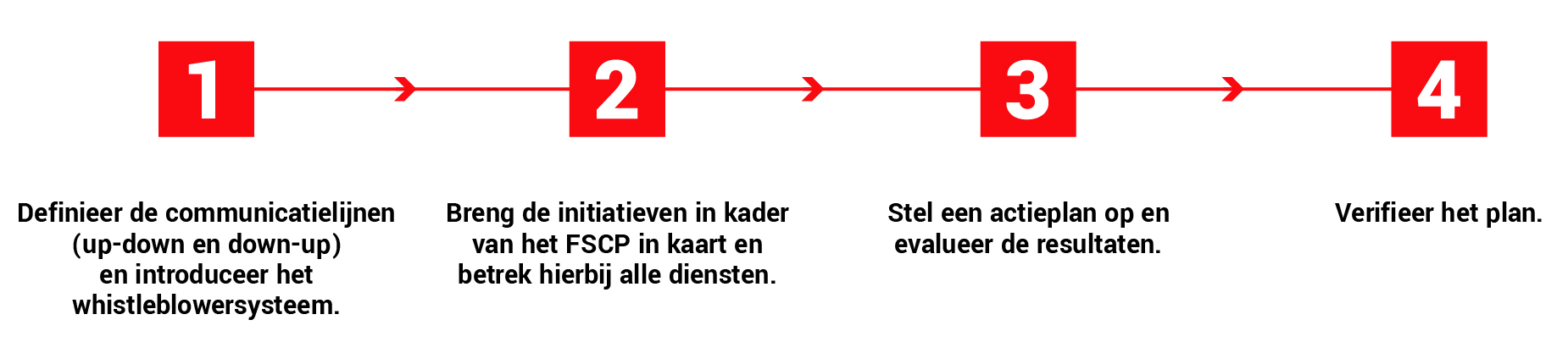
By following four steps, a company can set up an FSCP.
Our experience with the FSCP
We would also like to share our experience with this increasingly important part of current standards. How do companies experience this FSCP, and what is their attitude towards it? The reaction is often one of some reluctance and suspicion. We often hear comments such as "What are they going to come up with now?" or "I'm the production manager but also the owner, do I need to apply this too?"... Even so, we do see the value of this additional requirement, although we accept that there is a difference between small companies with fewer than 20 employees and companies with a considerably larger workforce. As companies grow larger, management's involvement often decreases, and it becomes harder for managers to know exactly what is happening on the shop floor. Such systems are then extremely well suited to restoring this involvement. In smaller companies, communication lines are much shorter, so information can be communicated more quickly. In these smaller companies too, the FSCP will ultimately lead to continuous improvement, something everyone can surely get behind.
Either way, implementing a Food Safety Culture Plan is an unavoidable requirement for achieving BRCGS Food certification, and soon IFS Food certification too.
AMNorman and the food safety culture plan
AMNorman has the right experts in house to provide tailored information. We can help you implement a food safety culture throughout your entire organisation.
Be ahead of the curve and get in touch with us. That way, your business will be ready for tomorrow's requirements.