Sustainability is becoming an increasingly important part of quality assurance in animal feed. Customers, dairy processors and regulators are no longer asking only about food safety, but also about transparency on origin, CO₂ impact and GMO-free production. Three themes come up time and again: the NZO White List, the LCA value of your feed and the VLOG label.
NZO White List
The NZO White List is a list of animal feed companies that dairy farmers supplying Dutch dairy processors (NZO members) are required to source their feed from. The list safeguards the safety and traceability of the entire dairy chain.
To be included on the NZO White List, an animal feed company must meet three conditions:
- be a member of Securefeed, Ovocom or AFS (or an equivalent scheme) for all relevant activities;
- be certified to GMP+ FSA (or equivalent) for feed safety;
- hold product liability insurance that meets the NZO requirements.
Not yet on the list, or at risk of falling off it? Our Feed team can help you set up your certification process so you keep meeting all the requirements.
LCA: the CO₂ value of your feed
Besides safety, customers are increasingly asking about the sustainability of animal feed too. Ovocom developed the DC-01 module (LCA value for feed) for this: a standardised method, developed together with Ovocom, BFA and Fegra, to calculate a feed's life cycle assessment (LCA) correctly and comparably.
An LCA value gives insight into a feed's environmental impact across the whole chain, from raw material to end product. For feed companies, this is an increasingly explicit request from customers who need to map their own chain CO₂ footprint.
VLOG: GMO-free animal feed
What is VLOG?
This isn't about YouTube videos, but about a voluntary certification that goes beyond legal requirements. VLOG stands for "Verband Lebensmittel Ohne Gentechnik", or in English: "Association for Food without Genetic Engineering". Producers who meet the requirements may display the VLOG logo on their packaging to show that their products contain no GMOs. To obtain the certificate, producers must follow 3 key rules:
- no genetically modified organisms, or parts thereof, are present in the product;
- no vitamins, flavourings, enzymes or other food additives produced using GMOs are present;
- no GMO material is present in the animal feed, with very strict limits that also apply if the animals were previously fed GMO-containing feed.
Why was VLOG created?
Simply because there's demand for it. A number of German retailers want to use it to respond to the trend towards healthy food and the fact that consumers increasingly want to know what is (or isn't) in their food and how it's produced. Through the "Ohne GenTechnik" seal, you give consumers the opportunity to make an informed choice and be assured they're getting the food they want. As a producer, you also show that you're happy to meet consumer preferences.
Who is VLOG important for?
When this label launched (2020), certification was limited to dairy products. Since then, its scope has broadened: alongside dairy, meat and eggs now also fall under VLOG certification, and the label now appears on almost every egg sold in German supermarkets. To obtain a VLOG certificate, the entire chain must be GMO-free: from the farmer producing the animal feed, through the livestock farmer, to the end product reaching the consumer.
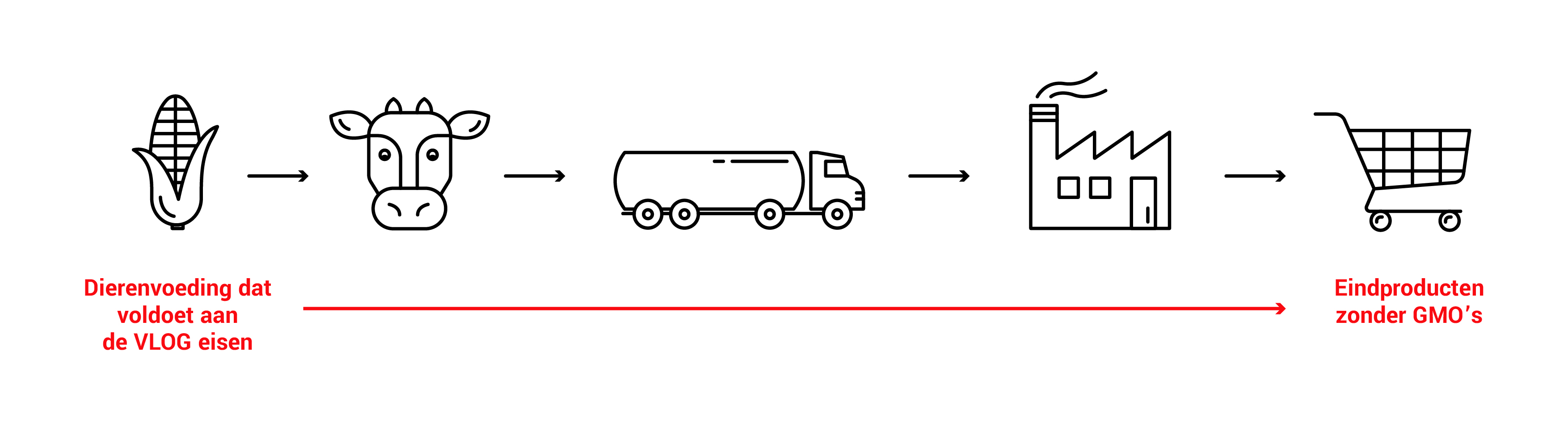
The chain illustrated above shows the route for dairy, but the same GMO-free principle now applies equally to the meat and egg chain.
For feed companies, this means demand for GMO-free (VLOG-compliant) feed keeps growing, including outside the dairy sector.
AMNorman and VLOG
Curious what the VLOG certificate could mean for you, or what its implications might be? AMNorman has the right experts in-house to give you tailored information or help you achieve the certificate.
Frequently asked questions
Does every animal feed company need to be on the NZO White List?
Only companies that supply dairy farmers who in turn supply Dutch dairy processors (NZO members) need this. The requirement doesn't apply to other markets, but the underlying GMP+ and Ovocom certification is usually a baseline requirement anyway.
Is an LCA calculation mandatory?
Not a legal requirement, but increasingly requested by customers who need to substantiate their own sustainability reporting.
How long does it take to get on the NZO White List?
That depends on your current certification status. If you're already GMP+ and Ovocom- or Securefeed-certified, being added is often a matter of weeks. If you still need to get certified, allow a few months.
Is VLOG certification mandatory for Belgian feed companies?
Not a legal requirement, but a growing demand from German and other European customers in dairy, meat and eggs who carry the "Ohne Gentechnik" label.
Questions about the NZO White List, LCA, VLOG or sustainability in your feed chain? Our Feed team is happy to think it through with you.
The "Ohne Gentechnik" label (VLOG) appears on the end product and shows that the entire chain, including the animal feed the animal was fed, is free of genetically modified organisms.