Forever chemicals in our food packaging
The term PFOS has been impossible to avoid in the press lately. However, this substance is part of a family of equally hazardous substances that we encounter every day in our food packaging: POPs. We would like to give the whole family a moment in the spotlight, so here is some explanation: what are POPs, what exactly is the problem with them and what does the legislator say about this?

Joyce Buysse
POPs versus PFOS
Persistent organic pollutants, or simply POPs, are organic substances that persist in the environment for a long time. POPs are manufactured for use in pesticides, solvents or industrial chemicals, or are formed as a by-product of certain other industrial activities. They accumulate in living organisms and, in that form, pose a risk to our health and the environment we live in, as they are toxic to humans and can eventually lead to conditions such as cancer and diabetes.
But what is the link with PFOS? PFOS (perfluorooctane sulfonic acid) is a chemical substance that makes products not only water repellent, but also grease and dirt repellent. Think of coatings for textiles, leather and so on. PFOS is also resistant to high temperatures, and is often found, for example, in the non-stick coating of frying pans and saucepans.
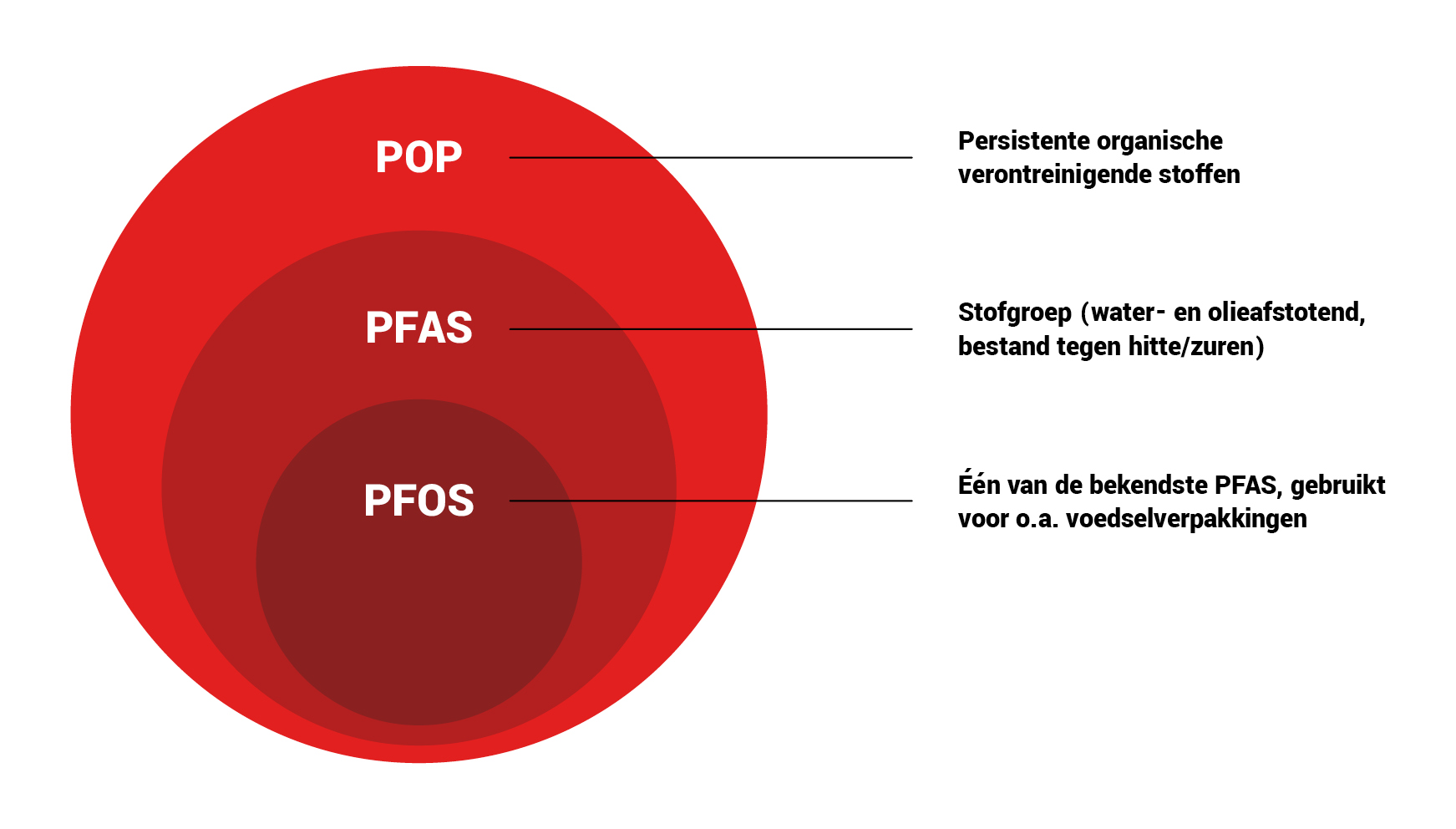
Members of the POP family include:
- pesticides (e.g. DDT, HCH, etc.);
- industrial chemical substances (such as polychlorinated biphenyls, which are widely used in electrical equipment); or
- unintentional by-products formed during industrial processes, degradation or combustion (such as dioxins, PCBs and furans).
POPs are a dangerous bunch that readily settle into our society and spread like wildfire. The preferred transport routes for POPs are air, water or migratory animal species. They travel internationally and reach places where they have never been produced or used. It goes without saying that no single region can tackle this issue on its own. Enter: international risk management.
This risk management resulted in a European POPs Regulation, born under the name Regulation 2019/1021. In concrete terms, this means that most of these substances are banned in Europe, and that strict restrictions apply to those that remain permitted.
What about food packaging?
The POPs Regulation is not, in principle, primarily aimed at packaging materials. However, as society pays increasing attention to sustainability and the environment, customers of packaging material manufacturers increasingly demand proof that the packaging produced also complies with the POPs Regulation. And, like most matters relating to food safety, that is complex.
The 'biodegradable' label is often applied to certain disposable packaging and is regarded by consumers as 'environmentally friendly' and 'sustainable'. It turns out that this type of packaging frequently contains PFAS, despite being 'biodegradable'.
The problem occurs mainly with food packaging made of paper, cardboard and pressed plant fibres. These materials are not inherently water or grease repellent, and are therefore given a treatment to acquire these properties. This is often where the problem lies. At least one in three such food packaging items would fail to comply with the POPs Regulation. And we will see increasingly more of this type of packaging, especially now that single-use plastics have been banned in Europe since 3 July 2021.
Since 2011, there has been a regulation for plastics (10/2011), which in practice means: a list of substances that may still be used in the production of plastic food packaging material. POPs are not on the positive list, so plastics that comply with Regulation 10/2011 are, in principle, 'safe'. Some caveats apply, however: the list does not, for example, apply to inks, colourants or solvents. It is therefore still necessary to investigate whether POPs are present in these. A plastic package may thus be 'safe', while the logo printed on it in ink, for example, is not.
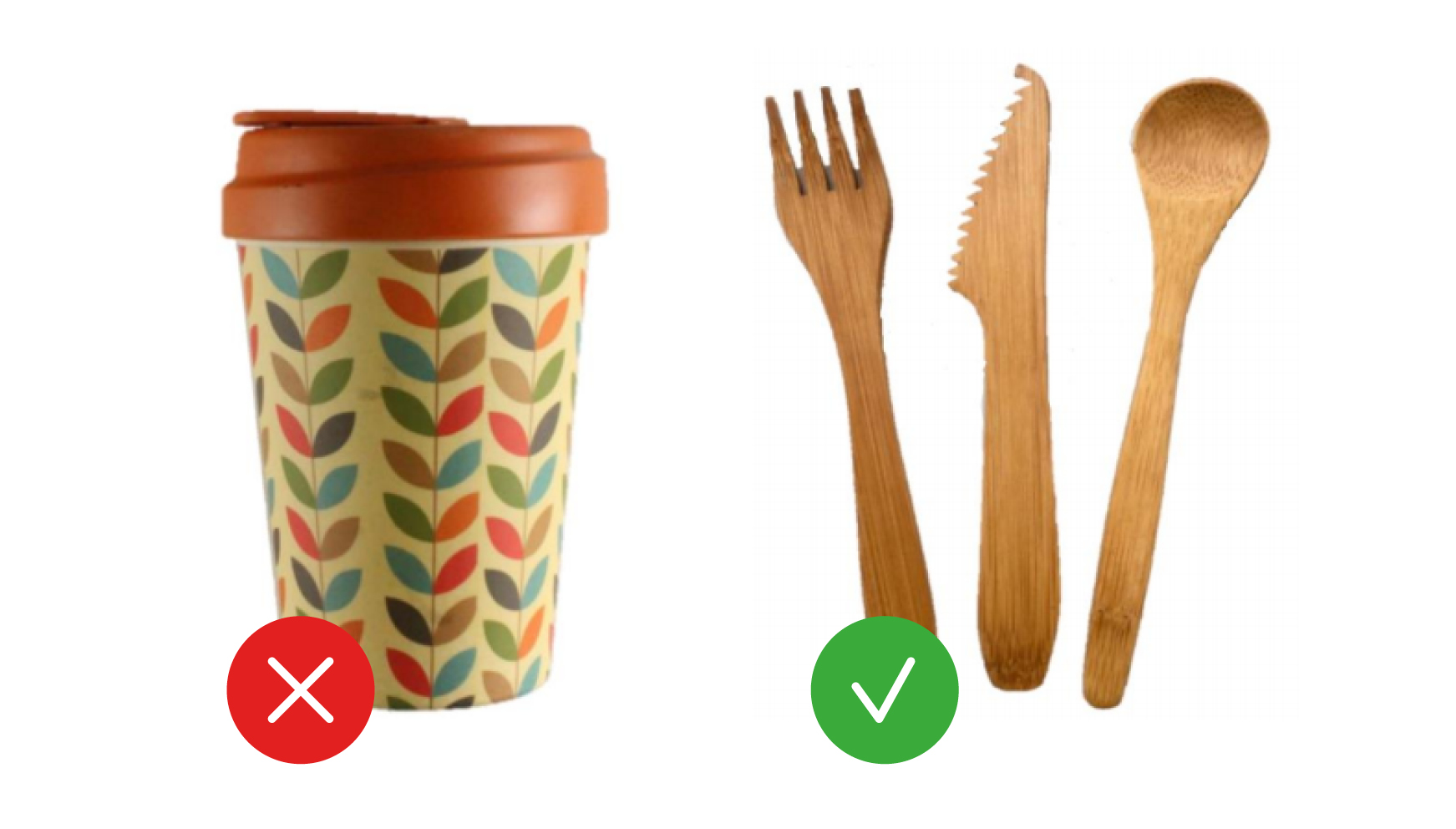
So what about alternatives such as bamboo, maize, rice and so on? In recent years, many food contact material manufacturers have turned to these. They produce material from plastic combined with plant fibres. What turns out to be the case? Banned on the European market since 21 May 2021. The effect of these products on our health has not been sufficiently assessed by EFSA, meaning they are not included on the list of permitted products. In short: plant fibres as an additive in plastic are strictly off limits. There is only still room for products made entirely from plant fibres, such as wood-look cutlery made from 100% bamboo, for example.
It is clear that POPs are everywhere and are best described as a hidden danger. In terms of legislation, we are making progress: thanks to European Regulation 2019/1021, swift action can be taken, but the actions still to be carried out remain a work in progress (biodegradable does not equal POP safe). So there is still work to be done before we can once again enjoy our coffee from a cardboard cup without worry.
Do you have further questions about POPs and related topics? Do not hesitate to contact us. We are happy to help!
Some further reading on the above blog post:
- https://eur-lex.europa.eu/homepage.html
- http://www.ejustice.just.fgov.be/cgi_loi/change_lg.pl?language=nl&la=N&table_name=wet&cn=2008090947
- FASFC circular on bamboo FCM (favv-afsca.be)
- https://www.efsa.europa.eu/en/news/pfas-food-efsa-assesses-risks-and-sets-tolerable-intake
- https://www.vlaanderen.be/pfas-vervuiling/pfos-en-pfas-waarom-zijn-ze-problematisch
- https://echa.europa.eu/nl/understanding-pops